
Did You Experience Poor Corn Pollination in 2026?
By Margaret Smith, PhD
Albert Lea Seed Agronomist
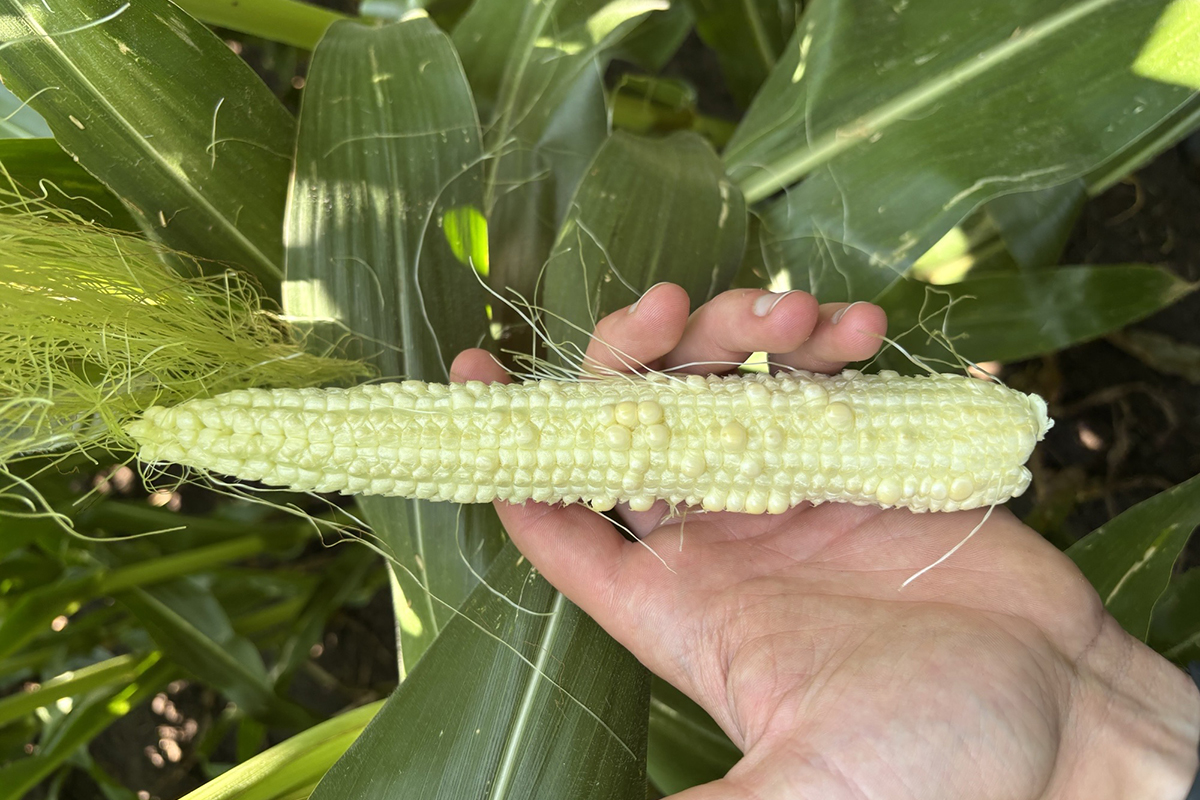
Photo above: An example of extremely poor pollination. Photo from northeastern Nebraska.
Parts of western Iowa and west into Nebraska and the Dakotas have experienced spotty or poor pollination with some hybrids this year. How much will this impact final yields?
The 2026 growing season has been characterized by drought conditions in the far western Cornbelt, while in most of the Upper Midwest they experienced good moisture conditions but fluctuating temperatures, with periods of high heat and humidity.
Corn pollination, of course, is a critical stage of development influencing crop yield. Coordination within the corn plant between silk growth and emergence from the ear tip and tassel emergence and pollen shed is a delicate ‘dance’ in which both partners—silks and pollen—need to arrive at the party at the same, or at the least, in the nick of time. This is why the coordination of silking and pollen shed is referred to as the ‘nick’.
Silk Development and Pollen Shed
Silking
Corn silks begin to grow, one from each potential kernel, at about growth state V12. Those from the base of the ear develop and emerge from the husk first. This growth process proceeds up the ear with silks from the tip emerging last. Silks grow up to 1.5 inches per day for the first couple of days, then slow their growth. Silks are receptive to pollen for up to 10 days after they emerge from the husk and are most receptive during the first 4 to 5 days. Silks stop elongation when pollen penetrates a silk cell wall. If a viable pollen grain doesn’t reach a silk, the silk continues to elongate for about 10 days after emerging from the husk. Extra-long silks on the outside of the husk may be the first indicator of poor pollination.
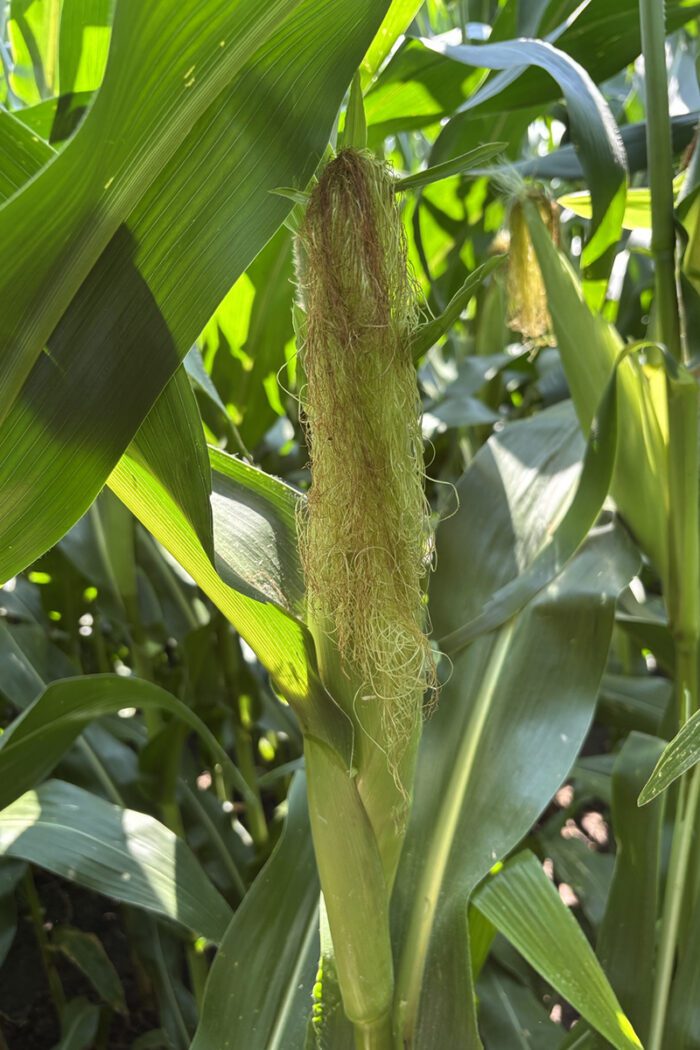
Above: Elongated silks indicate many were not pollinated. Brown silks likely did receive pollen.
Tasseling and Pollen Shed
Corn growth stage VT is reached when the last branch of the tassel emerges from the whorl. But, the top of the tassel may be visible while silks are emerging, confusing the distinction between vegetative and reproductive phase of the plant’s growth. Older hybrids tended to tassel first (reach VT), while silks emerged soon after (growth stage R1). Modern hybrids tend to exhibit silk emergence at or before tasseling. An individual corn plant produces A LOT of pollen—an estimated 2 to 25 million grains. Pollen is released from anthers beginning in the middle of the central tassel spike and progresses both up and down the spike. Peak pollen is usually released in the mid morning as anthers begin to dry out and open up. Some researchers have observed that pollen shed decreases at temperatures above 86° F. Shed may begin again in the evening as temperatures cool. An individual plant will release pollen for about 7 days, but with the variability of plant maturity within fields, pollen shed may be released throughout a field over a period of up to 14 days.
Factors Influencing Poor Corn Kernel Pollination
A number of factors can lead to poor pollination and kernel set:
1. Drought stress during the period leading up to tasseling and pollen shed.
Drought stress and high temperatures (particularly during the nighttime) speed corn growth and development and, in extreme situations, can result in all the pollen shed before silks emerge from the ear husk. When not extremely severe, a common characteristic of this phenomenon is fertilized basal or butt kernels because those silks were the first to emerge during the end of pollen shed. The rest of ears—from the middle to the tip—may be barren. Conversely, with some modern hybrids, stress may result in the silks emerging before tassels shed their pollen. Observation of individual hybrids is key to diagnosis.
2. Hot temperatures and low humidities during silk emergence and pollen shed.
Air temperatures at 95° F and greater can kill corn pollen. Fortunately, we rarely have 14 days of 95° F heat in the mid mornings, but it does happen. Usually some viable pollen is released during the time that silks are receptive. However, low humidity can dry out silks and pollen grains very quickly. Very hot AND dry conditions affect both pollen AND silk survival.
3. High humidity during silk emergence and pollen shed.
High humidity delays anthers drying from dew accumulated during the night and will prevent or delay pollen from being released. In fact, pollen isn’t shed during rainy conditions.
4. Silk clipping by corn rootworms or Japanese beetles.
Corn rootworm beetles and Japanese beetles can severely clip silks and either prevent them from receiving pollen or prevent the growing pollen tube from reaching the ovule on the ear.
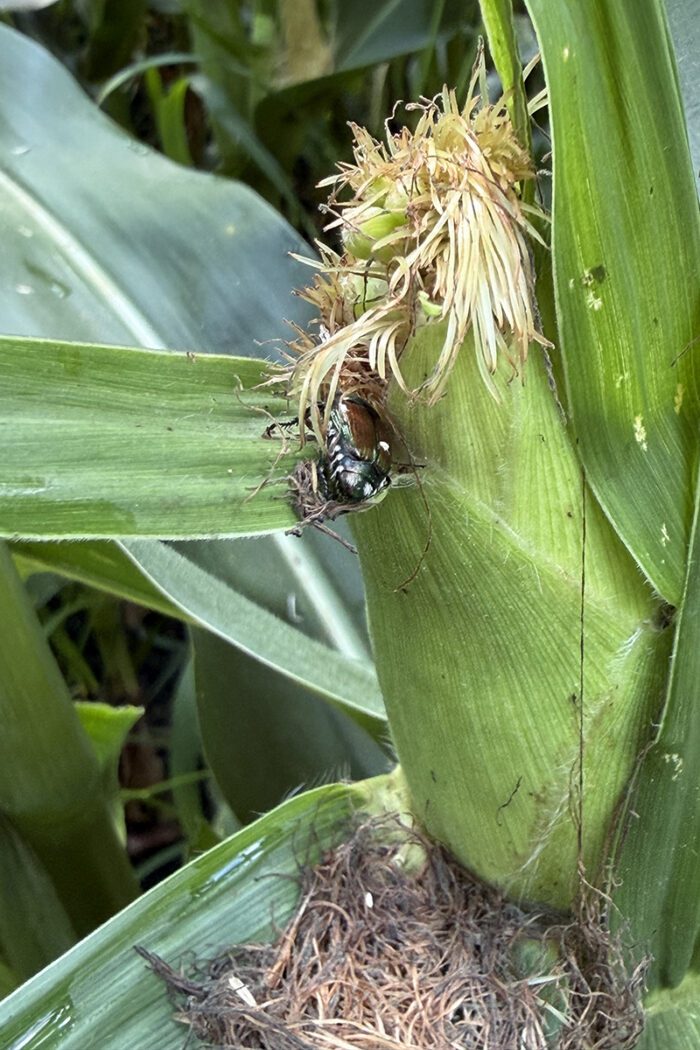
Above: Japanese beetle feeding on silks. Note cut silks on leaf below the ear.
5. Tassel Wrap.
Leaves wrapped tightly around the tassel can prevent or delay tassel emergence and pollen shed. This condition is related to high temperature and high moisture conditions leading to rapid plant grow in the vegetative stages. This was widely observed in 2025, but much less so in 2026.
6. Glyphosate application near tasseling (VT) on some hybrids.
What Factors Caused Poor Corn Pollination in 2026?
The causes of poor pollination are not always easily diagnosed. Best information is gathered from scouting about three weeks after pollinations, and another look while conducting yield estimates in late August or early September.
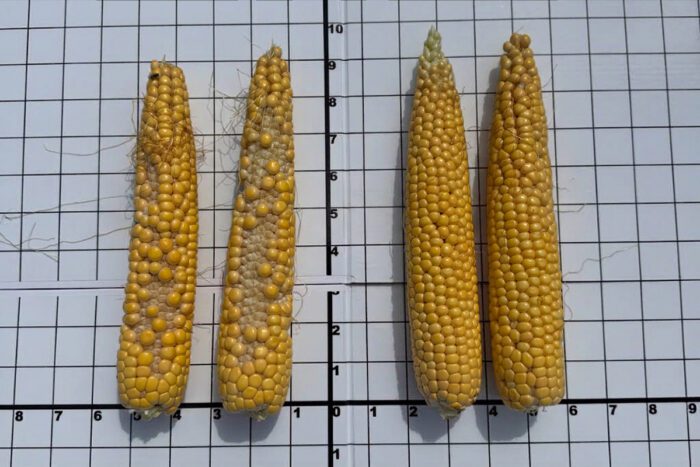
Above: Corn ears from West central Iowa. Same hybrid, same field. During pollination, the field experienced 90° F days and four nights in which temperatures didn’t get below 75°F. These days were very calm, with air speeds less than 5 mph.
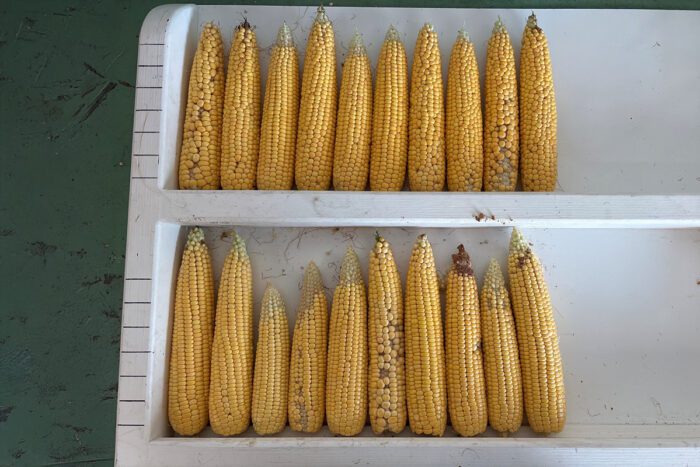
Above: Making yield estimates in west central Iowa, August 2026. Two hybrids of similar maturities were both affected by stress conditions. Photo courtesy Heather Poutre, Agronomy Diversified LLC, Boone, IA.
Potential Yield Loss
Bob Neilsen, from Purdue University, illustrates potential yield loss form unfertilized kernels.
“The potential loss in grain yield caused by lower kernel numbers per ear can be estimated using the formula of the Yield Component Method (Nielsen, 2021a). For example, the loss of only 1 kernel per row for a hybrid with 16-row ears and a stand count of 30,000 ears per acre would equal a potential yield loss of approximately 5 to 6 bushels per acre (1 [kernel] x 16 [rows] x 30 [thousand ears per acre] divided by 85 [thousand kernels per bushel]). Actual yield loss due to poor kernel set is a bit more complicated because of the potential for compensating changes in kernel weight by the remaining kernels on a poorly filled ear (Jeschke et al., 2025).”
Pro Farmer, following their 2026 field tour, estimates Nebraska corn yields at 20 bu/A fewer than the 2026 USDA estimate and down 16 bu/A compared to 2025 yields. Similarly, a private crop consultant based in Boone, Iowa has just completed corn yield estimates for her clients and estimates corn yields will be down 25 bu/A this year compared with 2025 yields. Yield in the unirrigated drought-stricken parts of the Dakotas may well see greater yield reductions.
It appears that may of these pollination-related yield losses may not be large enough to trigger crop insurance claims, but there will be some severe situations, particularly in Nebraska and the Dakotas, where crop insurance claims may kick in.
__
References
- Causes for Poor Kernel Set in Corn, Purdue University
- Corn Pollination: Effect of High Temperature and Stress, Iowa State University
- Corn Silk Clipping Insects and Economic Thresholds, University of Wisconsin—Madison
- Extended High Heat Disrupts Corn Pollination, University of Nebraska-Lincoln
- Heather Poutre, crop consultant and owner, Agronomy Diversified LLC, Boone, IA (personal communication, 9/4/2026)
- Humidity and Temperature Impacts on Corn in 2026, University of Nebraska-Lincoln
- Pro Farmer crop tour day 2: Lower Yield results (8/19/2026)
- Silk Development and Emergence in Corn, Purdue University
- Tassel Emergence and Pollen Shed, Purdue University
- Tassel Wrap in Corn, Jeschke, et al., Pioneer