
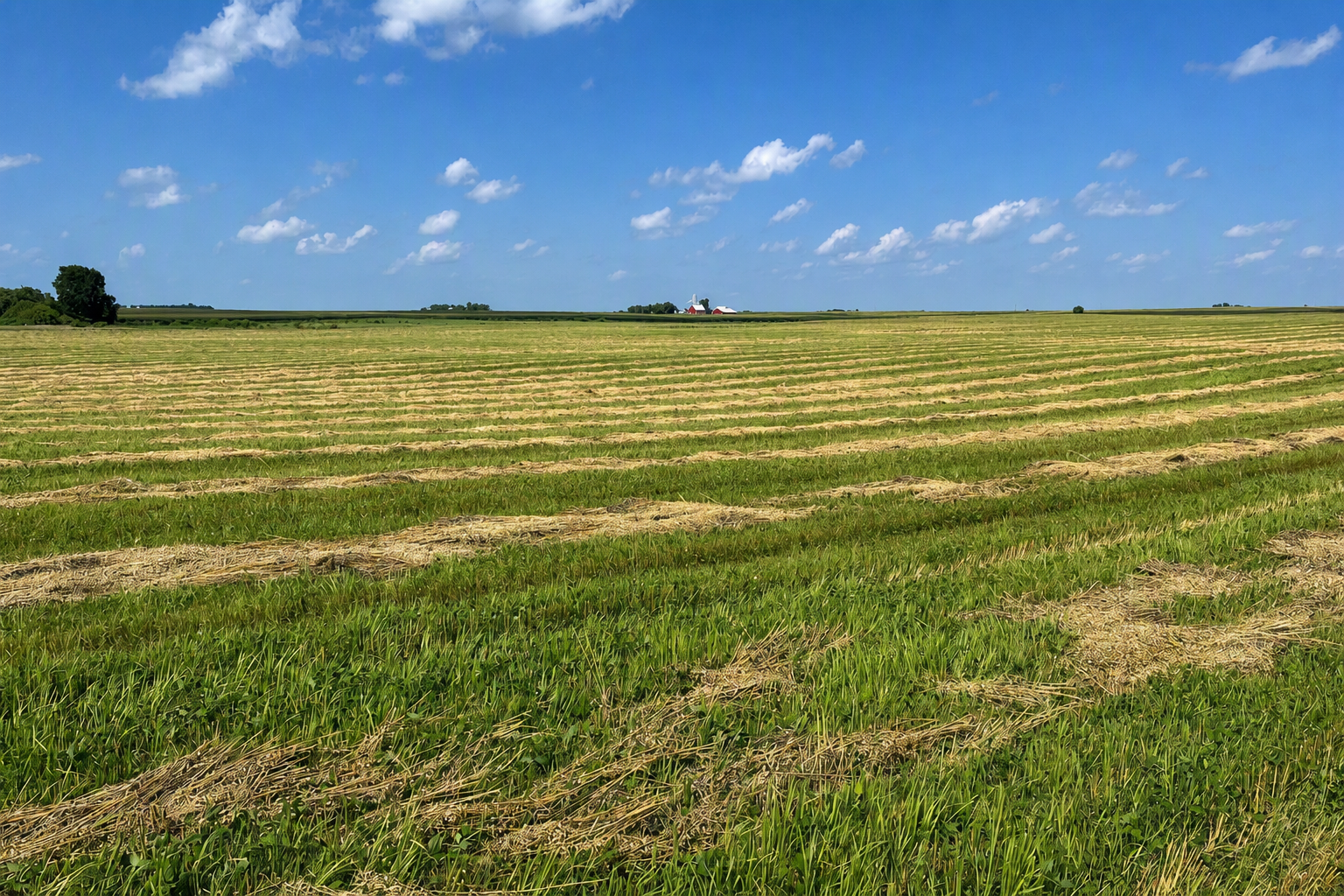
Photo above: Swathing is an option for harvesting green-stem oats.
By Margaret Smith, PhD
Albert Lea Seed Agronomist
Many oats across the Upper Midwest appear to be mature and ready to harvest but retain green stems, making them VERY difficult to combine standing. What’s going on?
When are Oats Mature?
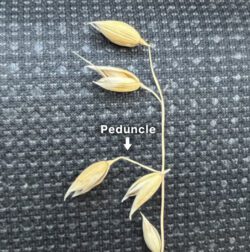
The first thing growers need to do is check the maturity of their oats. Have they reached physiological maturity? The University of Minnesota covers this well in Physiological Maturity in Wheat, Barley, and Oat. They provide two visual indicators of crop maturity—listed below. (Most growers don’t check the color of the peduncle on their oats before deciding to harvest, but should!)
1) Loss of green from the kernel – The first indicator is the loss of green in the kernel, and the appearance of a dark layer of cells or pigment along the crease. Kernels in the same spike will reach physiological maturity at different times, with the middle of the head maturing first.
2) Loss of green from the ‘peduncle’ is another visual indicator of maturity. (An oat peduncle is the slender, arching stalk that connects the main stem to the individual spikelets in an oat panicle. It acts as the delicate, nutrient transport pathway and physical support structure from which the oat grains hang.) At this time of color change to tan, the transportation of water and nutrients to the head has been cut off, and the crop has reached maximum grain fill.
Why do Mature Oats Sometimes Retain Green Stems?
Once oats are physiologically mature, some persist in retaining green stems even though no more carbohydrates can be transported to grain. A number of oat varieties have this ‘stay green’ attribute.
“This is a genetic trait selected by breeders that was thought to boost yield and quality by keeping the canopy green longer. In cooler climates that may work but we have learned that under our Upper Midwest conditions (warm, more humid climate) it doesn’t work very well because the grain reaches physiological maturity (maximum dry weight) before the lower canopy decides to quit and dry down. Heavier soils with better water holding capacity aggravate this problem further as do fungicides (by keeping the canopy healthy and temporarily blocking an enzyme, nitrogen reductase, in the canopy). Even lodging seems to make it worse” (Jochum Wiersma, 2026).
How to Harvest Oats with Green Stems or other Green Plant Materials
There is a temptation to sit tight and wait for stems to dry down, but this will result in grain shattering and yield loss. There are good, fair and poor alternatives to getting these oats with green stems harvested.
Good Options:
1. Use a stripper head. Straw will need to be mown and baled afterward or chopped and left in the field. Stripper heads do not deal well with lodged oats.
2. Swath the oats and harvest with a pickup head. Straw can be handled as typically done with your combine. This is THE best option if you also have weeds in the field or a tall hay or legume underseeding.
You may be able to locate these pieces of harvest equipment or hire custom harvesters as their time allows, but this equipment isn’t common in many locations. Trying to purchase this equipment at harvest time is not a viable option for most producers.
Fair Options:
1. Raise your platform head and try to cut above the green portion of the stems. There is a limit to the effective height as the angle changes of your cutting edge and affects cutting effectiveness.
2. Use an older combine with shakers (straw walkers) rather than one with rotors. The shaker mechanism handles green, wet straw much better than rotors do. (Rotary combines labor mightily when sending green oats stems through them.) Vintages of combines with this technology vary. A few of these are still being manufactured, but there are various combine models manufactured pre 2000, or pre 1990 for Case IH models with the traditional shaker technology.
Poor options (these all require pick up heads for combines to be able to thresh for grain):
1. Some folks have tried cutting their oats with a hay mower/conditioner and opening up the crimping rolls. You WILL lose oat grain with this option. Folks may be attracted to this if they have green material coming up through the oats and they don’t want to wait any longer for stems to dry down. I’ve never seen a measure of how much loss may be incurred with a mower. It does get the grain harvested.
2. Sickle bar mowers with a windrowing attachment. This is a bit historic and only cuts a swath as wide as the sickle bar—7’ or 9’—but works pretty well. These windrowing attachments are no longer made but perhaps could be fabricated. The limited width of sickle bars and the small windrow makes this option unattractive for most growers. In addition, the windrow may not provide enough material to thresh out well in larger, more modern combines.
3. A disc mower (no crimper) lays down a windrow. This works okay, but some grain will be lost. I have never seen a measure of how much loss may be incurred with this method.
These cutting options all require pick up heads for combines to be able to thresh the grain.
Is Chemical Dessication an Option for Dry down?
For food-grade, milling oats, neither Grain Millers nor Green Acres Milling will take oats for food milling that have been dessicated with glyphosate. It apparently changes the milling properties. Always check with your buyer before applying a dessicant.
Taking the Long View
Oat growers need to take the long view and have a plan ‘B’ in place before oats ever go in the ground—or a year or more beforehand. The long view may involve purchasing additional equipment: a swather, pick up head, or stripper head. Consider, too, partnering with a small group of oat growers and evaluating a joint equipment purchase. Pick up heads would need to be owned individually, but a swather could be shared.
There are methods to arrange these business arrangements (see: ‘Joint Machinery Ownership’ in Iowa State’s Ag. Decision Maker). Joint ownership come with its own challenges—and they usually aren’t mechanical. But, new crops, particularly those grown on smaller acreages, will require creative thinking and business management to make them work.
__
References
- Abbas, Matt, farmer, Latimer, IA personal communication, July 17, 2026
- Alert, Doug, farmer, Hampton, IA personal communication, July 16, 2026
- Olson, Jonathan, farmer, Cottonwood, MN, personal communication, July 17, 2026
- Peduncle Breaking Resistance: A Potential Selection Criterion to Improve Lodging Tolerance in Oat, Canadian Journal of Plant Science
- Physiological Maturity in Wheat, Barley, and Oat, University of Minnesota
- Rotary vs. Straw Walker, The Farming Forum
- Small Grain Harvest Options, South Dakota State University
- Wiersma, Jochum, UMN, personal communication, July 16, 2026