
Is Your Oat Stand Good Enough to Keep?
By Margaret Smith, PhD
Albert Lea Seed Agronomist
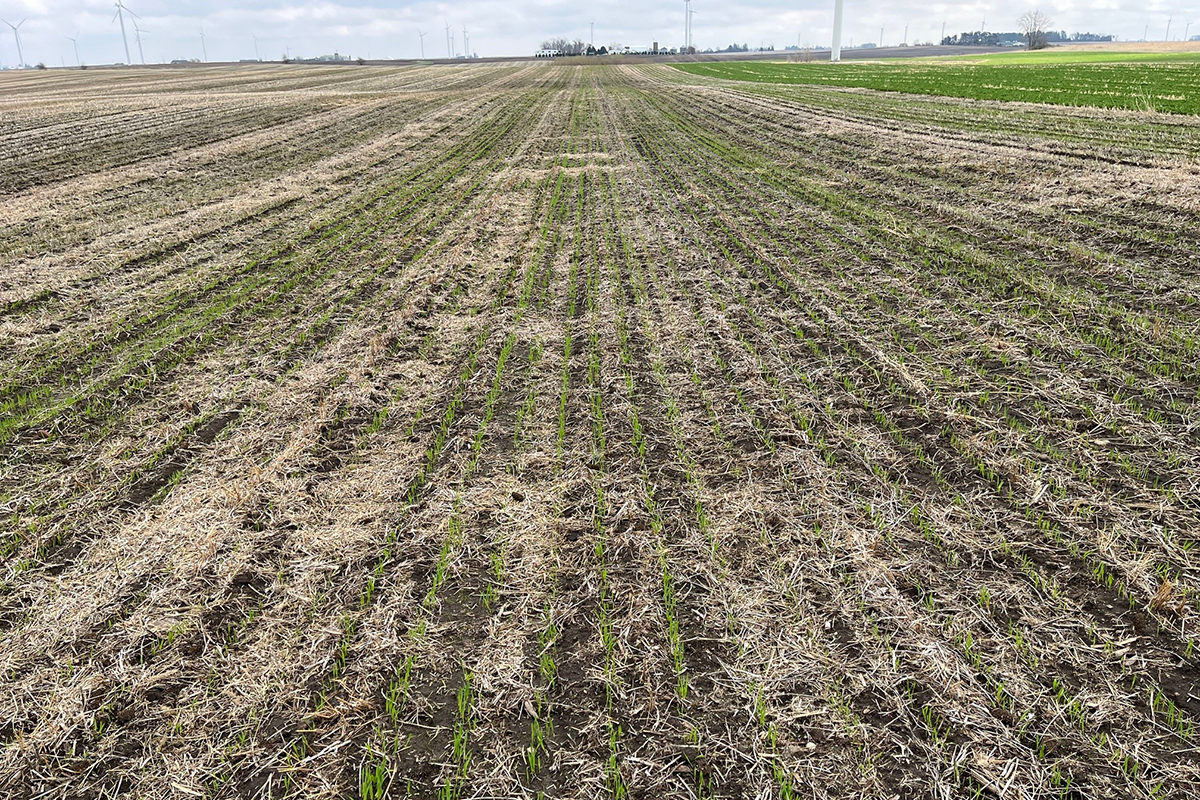
Photo above: SD Ranger Oats seeded March 26, 2026 in Bradford, IA. Photo taken April 15, 2026.
Growers in northern states are feeling a bit nervous with the cool later March and April temperatures, watching their oats slowly emerge. Emergence is a bit uneven, though plants are still coming!
Oat Stand Establishment
Oat (as well as spring wheat and spring barley) plant and stand establishment have several phases. The first is water uptake or imbibition. Once the imbibition phase starts there is no return to dormancy and germination and emergence should be as quick as possible to establish a healthy, vigorous seedling. Spring small grains can take up cold water—they aren’t susceptible to the cold water imbibition that can affect corn and other warm-season crops. The imbibition or ‘water uptake’ phase is a passive process, and if the seed freezes during this phase it will eventually rot. This can be a source of stand loss. Though it seems counter intuitive, this provides a good argument for slightly deeper planting—2” to 2 1/4” when planting early—to avoid freezing soils at seed depth.
Spring small grains will start germinating in earnest when soil temperatures at seeding depth reach 40⁰F. Germination means that the germ starts growing. Once the germ is actively growing, it has some tolerance to freezing temperatures. It can tolerate temperatures down to 28⁰F and probably even handle short periods of temperatures as low as 22⁰F.
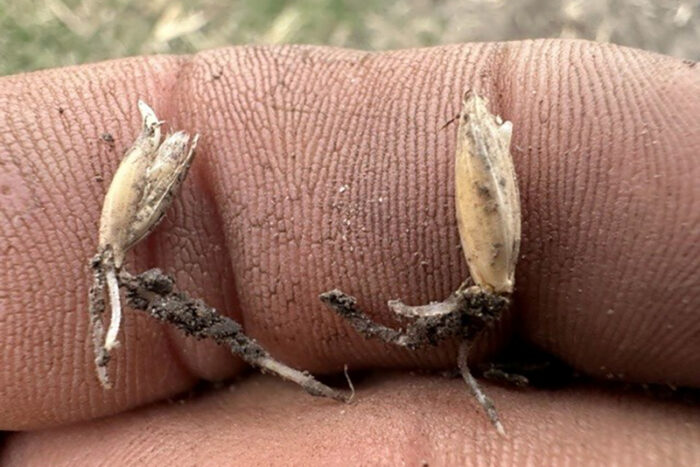
Oat growth after 12 days in the ground, 2026. Photo: Ken Pecinovsky.
What is a ‘Keeper’ Stand for Oats?
It’s too early to make the call on oat stand counts today, April 17; plants are still emerging. At this point, watch slower emerging areas of your fields, daily. Oats have a great capacity to live and grow slowly through cold temps. I’ve experienced 30 days after seeding before plants finally emerged and achieved excellent stands.
The seeding goal for oats is to achieve 29 plants per sq ft, but by mid to late April, with uniform stand reductions, conventional stands with 15-17 plant per sq ft are worth keeping. Remember that these plants will still tiller and can fill in a thin stand.
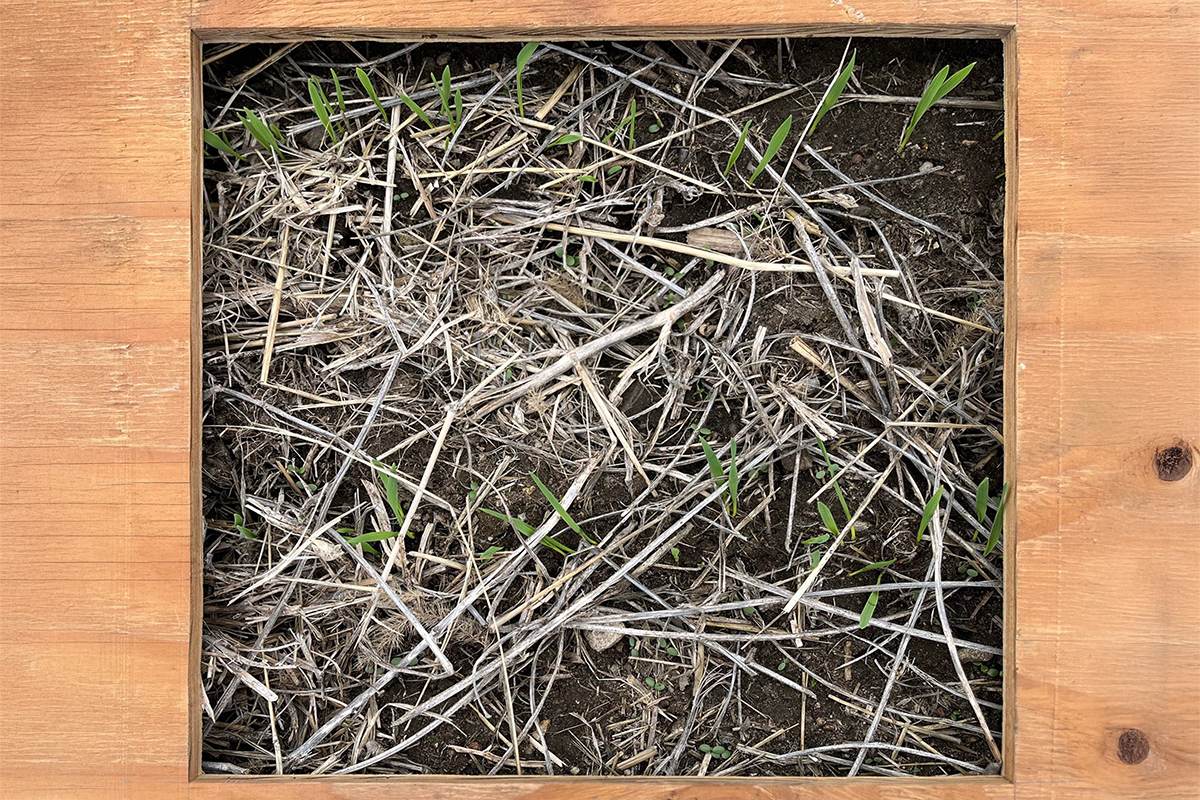
Square foot measurement of oat stand with 37 seeds per square foot.
The question of whether to keep or abandon an oat stand is influenced by several factors including uniformity of stand loss, whether there is hay underseeding with the oats, if the stand is for grain or forage, and whether the production system is organic or conventional.
1. Uniformity of the stand loss.
Stand loss is not typically uniform. Lower, wetter areas stay cooler and may emerge later than areas when soils warm faster in the spring.
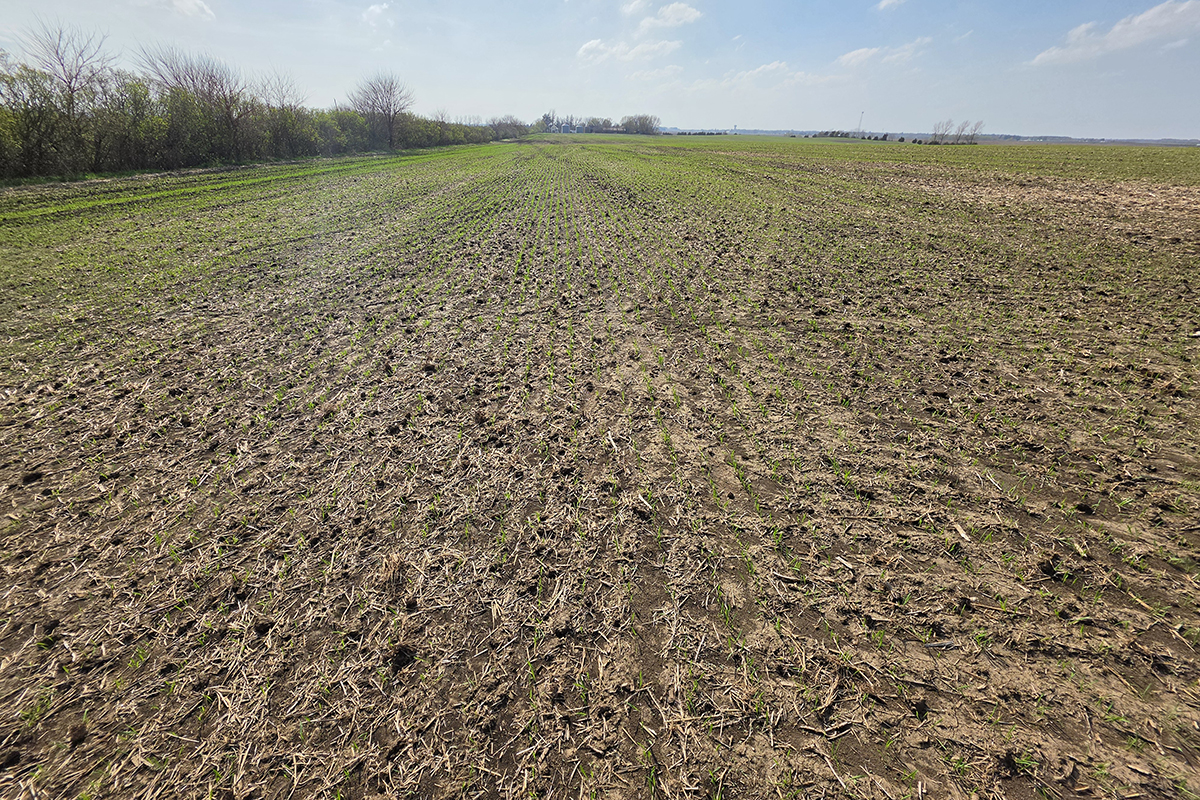
Sumo oats, seeded March 24, 2026. Photo taken April 14, 2026. Emergence isn’t uniform across the field. Photo: Ben Abbas.
Areas with more crop residue, such as last year’s corn fields and oats no-tilled into soybeans where the straw/chaff spreader may have been a bit ‘off’, leaving strips with heavier residue will emerge more slowly than the rest of the field.
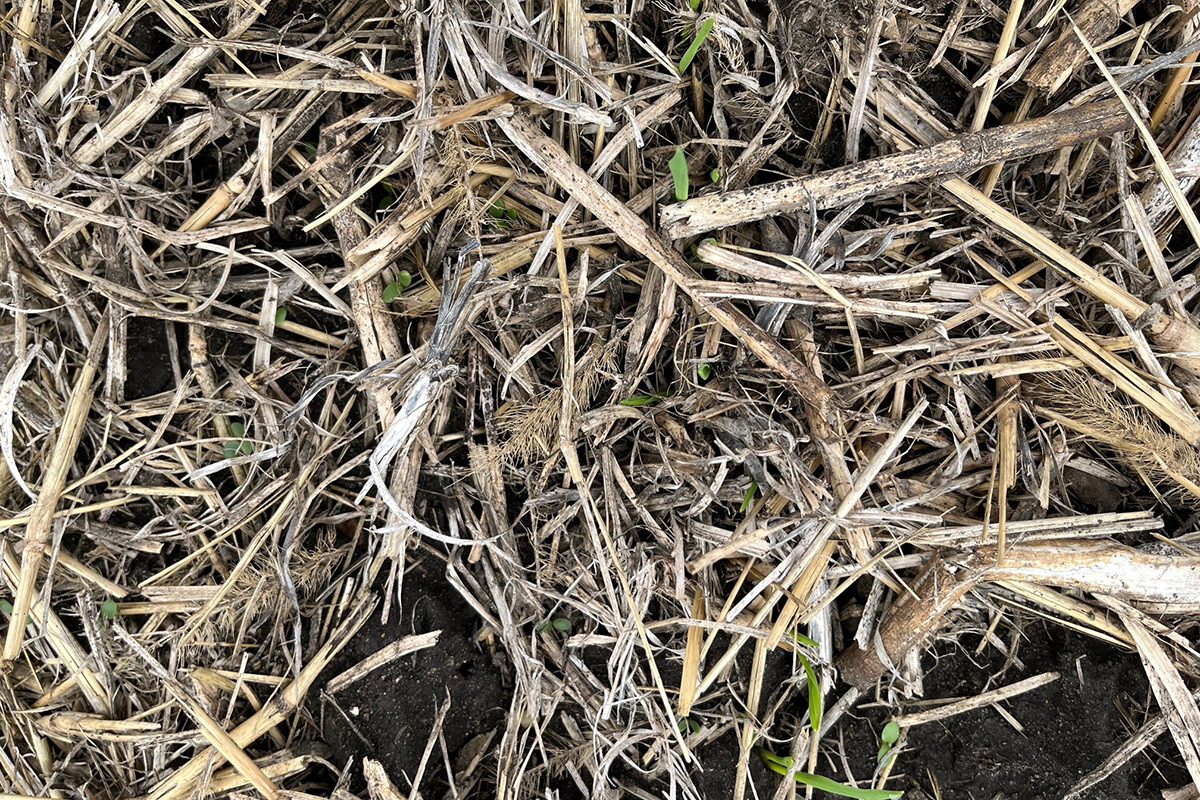
SD Ranger oats emerging slowly through soybean residue. Photo taken April 15, 2026.
If areas with poor stands are large enough, you can either rework those areas and plant a cover crop or interseed additional oats. This latter is a poor option, because the maturity will differ considerably between the seeding dates. These areas though, if accessible, can be used for hay or haylage.
2. Is there a hay underseeding with the oats?
The hay crop is the more important of the two crops, or as I refer to it, “The Main Event” (of the seeding). With money sunk into the hay seeding, rather than destroy a stand, you can withstand slightly lower oat populations, about 12-14 plants per ft 2, than you may have planned. To help compete with weeds, you may need to harvest the oats early for forage rather than taking them to grain and add an extra mowing pass during the season for additional weed suppression.
3. Is the stand for grain or forage?
Thinner stands that were intended for grain production can be salvaged by harvesting the crop for haylage, balage or hay. Time the forage harvest from the boot to soft-dough stages. Earlier harvesting will cut a lot of weeds before seed set. This allows ample time to establish another summer forage crop or mixed cover crop seeding.
4. Is this an organic or conventional production system?
Conventional oats may have had a preplant herbicide applied which will allow getting by with a thinner stand. There are also post-application options for broadleaved weeds where there is no legume underseeding. Grassy weeds may become a problem, though. In a conventional system, use the 15-17 plants per ft2 guideline to keep the stand.
Organic growers rely entirely on competition from the oats for their weed suppression. Thick and uniform oats are the key to good weed control.
Organic ‘keeper’ oat plant populations are in the range of 18-20 plants per ft2. Fewer than these plants uniformly distributed across the field will result in considerable weed pressure, particularly foxtail and giant ragweed.
With irregular losses across the field, plants can compensate and fill in for one missing row in a drilled stand, but with gaps of two or more adjacent rows and/or more than about five ft. along the length of the rows, both yield and weed control will suffer. Terminate oat stands with low populations and irregular stand gaps within the field OR harvest early for forage and replant a summer annual grain or forage. A good, solid stand for a spring-planted crop will benefit overall yield and the better weed control will yield economic benefits in both this year’s and following crops.
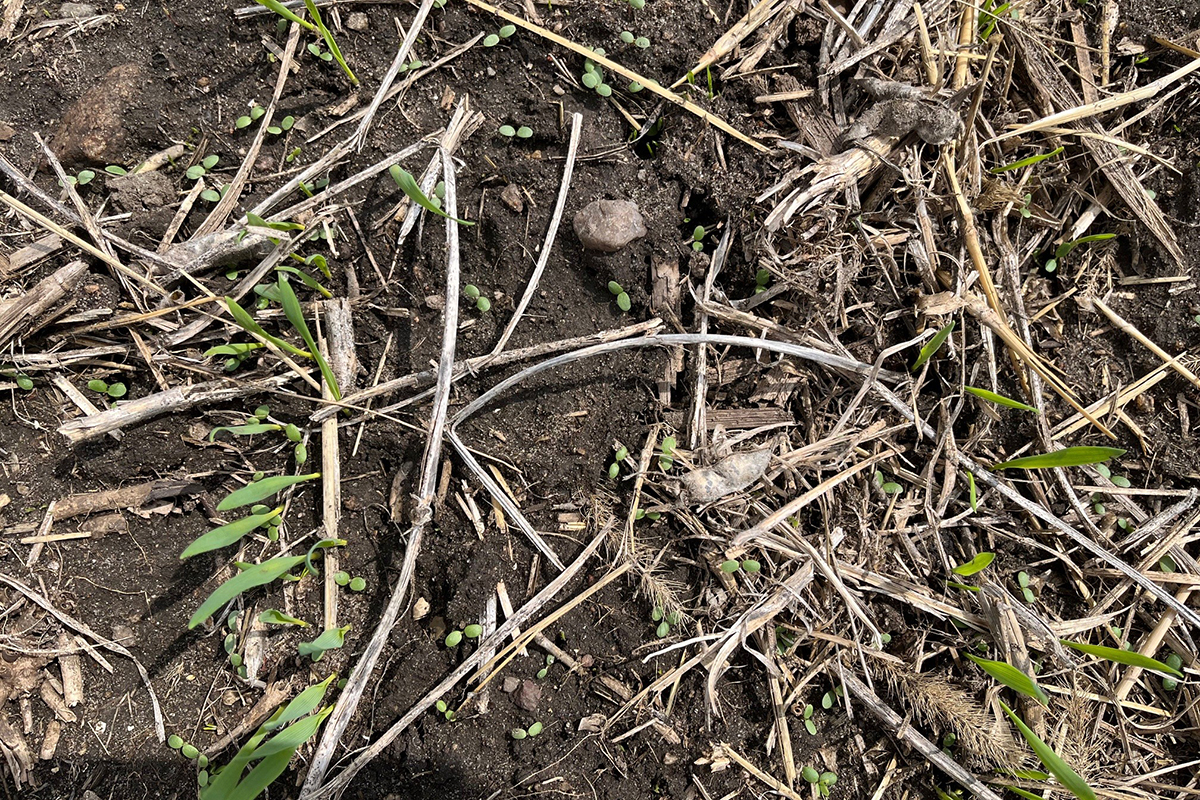
Good news! Red clover underseeding is emerging with these Organic SD Ranger oats.
Table 1: Albert Lea Seed suggested ‘keeper’ stands for oats in several scenarios.
| Oat Scenario | Intended Use | Plants / Square Foot | Plants / Linear Foot of Row (7.5" Row Spacing) | Plants / Linear Foot of Row (7.0" Row Spacing) |
|---|---|---|---|---|
| Organic | Grain | 18 - 20 | 11.3 - 12.5 | 10.5 - 11.7 |
| Organic | Grain with Underseeding | 15 - 17* | 9.4 - 10.6 | 8.8 - 9.9 |
| Organic | Forage | 17 - 19** | 10.6 - 11.9 | 9.9 - 11.1 |
| Conventional | Grain | 15 - 17 | 9.4 - 10.6 | 8.8 - 9.9 |
| Conventional | Grain with Underseeding | 12 - 14* | 7.5 - 8.8 | 7.0 - 8.2 |
| Conventional | Forage | 14 - 16** | 8.8 - 10.0 | 8.2 - 9.3 |
Measure plant stands either by square foot or linear foot of row. When measuring by linear foot of row, count at least a 3-ft length at each evaluation site. Measure stands AT LEAST five sites in the field—MORE if stand loss is inconsistent across the field.
*With low oat populations seeded over hay or cover crop seedings, remove oats as forage early and be prepared to mow throughout the season to suppress weed growth and seed set.
**With low oat populations intended for forage harvest, harvest early and be prepared to mow throughout the season to suppress weed growth and seed set or seed another forage mix, early.
__
References
- Did I Pull the Trigger too Early?, University of Minnesota
- Did Your Small Grain Survive the Winter? Evaluation and Next Steps, Albert Lea Seed
- The Sowing Density On Oat Productivity Indicators (2017, Brazil), African Journal of Agricultural Research
- Variation and Interrelationships in the Growth, Yield, and Lodging of Oat Under Different Planting Densities (2024, China), PeerJ
- When is Early or Too Early to Plant Wheat Barley or Oats?, University of Minnesota
- When is it too Late to Plant Oats, Wheat, or Barley? Management Considerations for Late-Spring Planted Small Grains in 2023, Albert Lea Seed
- Wiersma, Jochum, UMN, personal communication, April 15, 2026