By Margaret Smith, PhD
Albert Lea Seed Agronomist
“When the apple trees blossom, that’s when it’s time to plant corn. That’s what my grandpa used to say, and there is a lot of truth to it.”
Ray Yokiel, Wells, Minnesota (began farming organically in 1984)
“Plant corn when oak leaves are the size of a squirrel’s ear”
Delmar Coon, Hartford, Iowa (began farming in 1930)
These are phenological observations, sometimes used to gauge the best times for farming and gardening operations. Phenology is known as ‘Nature’s Calendar’. It’s the study of the timing and cyclical patterns of events in the natural world, particularly those related to the annual life cycles of plants, animals, and other living things and a field of ecological research that helps us understand how living organisms respond to environmental cues such as day length, temperature, and rainfall.1 These examples, above, involve watching the development of a perennial species and using that species development to gauge the time to plant an annual species—corn.
Winter temperatures clearly influence the development of perennials (e.g. oak and apple trees and ornamental flowers) and winter annual plants (e.g. winter rye and wheat). In the past, winter temperature didn’t fluctuate much from year to year, which led to farmers observing and using phenological indicators from perennial plants as keys when to plant their annual crops. Pretty handy!
Are phenological observations useful for planting organic corn in 2026?
Organic corn production, with no fungicide seed treatments, has some similarity to our grandfathers’ and great-grandfathers’ systems, but there are many differences. Today’s organic corn genetics have top notch yield potential and increased cold tolerance, we have much better machinery options for weed control, including autosteer and other guidance assistance, and we use cover crops. Should the timing of corn planting be the same as in those historic systems?
A big difference influencing our farming decisions today is the change in climate and weather patterns. This influence differs somewhat across regions in the U.S. In the Midwest, we’re experiencing overall greater rainfall, more extremes in wet and dry periods, and warmer winters than we did 30 years ago.
Phenological indicators can be useful in evaluating a past season, but are NOT indicative of the upcoming growing season. We surmise that they are no longer useful in predicting organic corn planting dates.
Our general rules of organic corn planting are to:
- Delay planting two to three weeks after conventional corn has been planted to allow soils to warm (though soil temperature is a better indicator than calendar date)
- Plant with favorable weather in the forecast
Why Wait to Plant Organic Corn?
1. Temperature Controls Corn Emergence.
Corn germination and emergence are driven by soil temperatures and moisture. Corn takes about 100 to 120 accumulated Growing Degree Days (GDD-Base 50) or heat units (air temperatures), from the time of planting to emergence. As spring progresses and days warm, greater numbers of GDDs are accumulated each day. For this reason, corn emerges more quickly when planted later in the spring. In a Minnesota experiment, conventional corn emerged in 25 days when planted April 15, but in only nine days when planting on May 10.
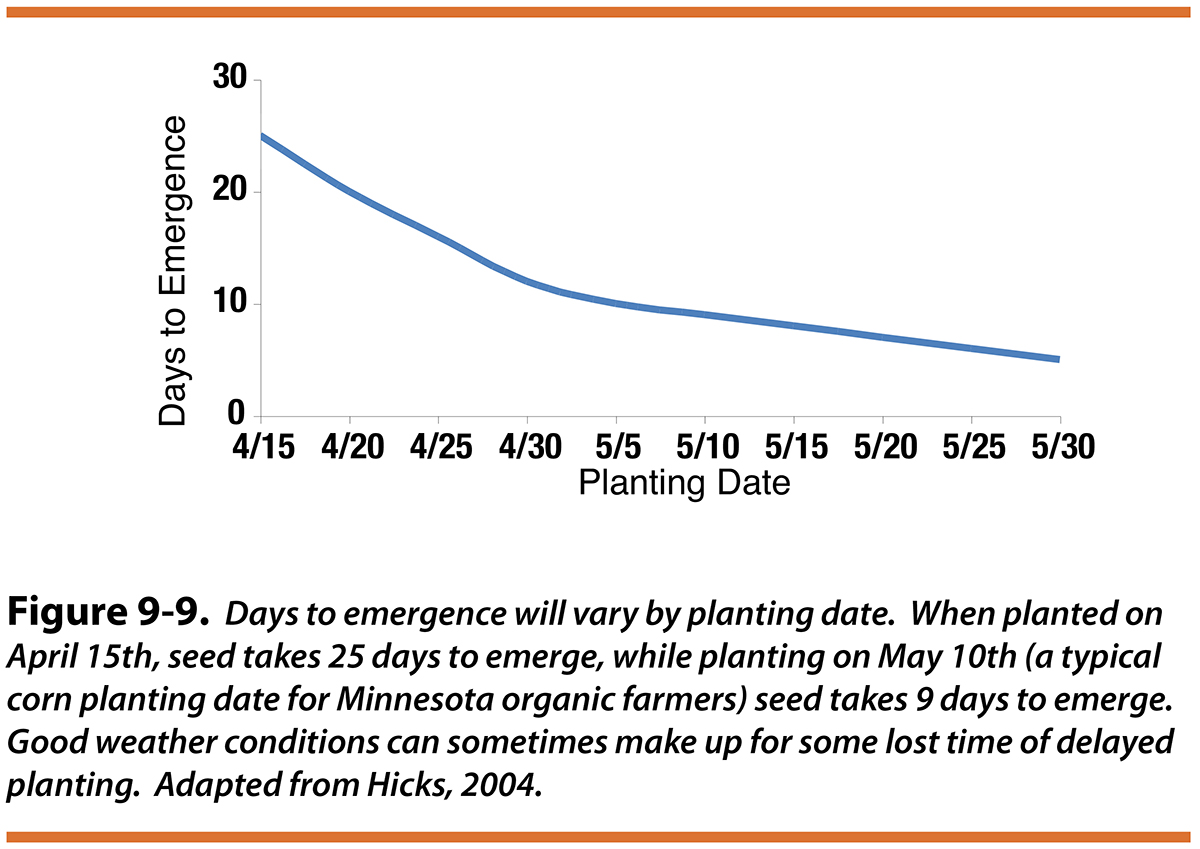
Graph from University of Minnesota, Risk Management Guide for Organic Producers, Chapter 9: Corn Production
To track growing degree day accumulations, you can access an official weather station near your farm at the following websites:
Soil temperature of 50°F and rising is the accepted threshold for planting conventional corn. Corn hybrids are more cold-tolerant than in the past, but conventional fungicide and insecticide seed treatments—which are not approved for organic agriculture—are the biggest reasons why corn planting can be pushed earlier. Organic corn needs warmer soil temperatures for rapid germination and emergence.
2. Plant Population
The most important reason to delay planting organic corn is to improve your chances of a good, uniform stand. Corn seed that sits in cool, moist ground for five days or more is subject to insect feeding and fungal seed rots, which can reduce corn plant populations. Current OMRI-approved organic seed coatings are not equivalent to chemical fungicides/insecticides. Organic seed coatings (like Albert Lea Seed’s ‘Rise Up’) have no activity on pythium, fusarium, or rhizoctonia soil-borne fungal diseases or on seed-eating insects such as seed corn maggot and wireworms. These seed coatings are to enhance crop growth.
Tracking Soil Temperatures to Guide Time of Planting
Ideally, organic corn should emerge in five to six days after planting to avoid seed rot and insect feeding. To achieve that, soil temperatures need to be at 50°-52°F or higher at a 4” depth (55° F at seed depth) and GDDs (calculated using air temperatures) accumulating at a rate of 20 to 25 units each day.
To track soil temperatures (reported at 4” depth), check these websites:
- Minnesota
- Iowa
- North Dakota
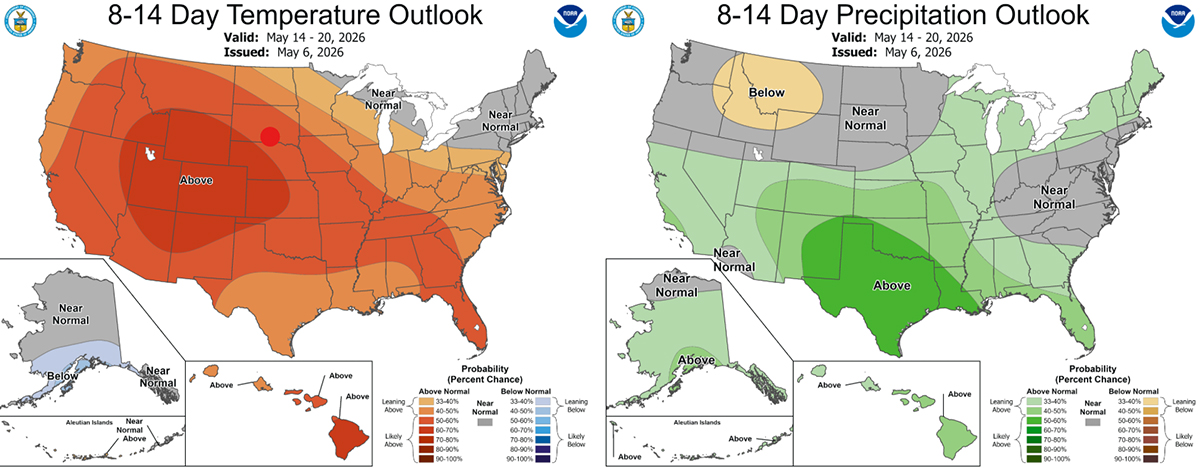
Once soil temperatures have reached 52°-55°F consistently for 2 to 3 days, check the long-term forecast from the National Weather Service Climate Prediction Center and your local forecast for the coming six days. It’s best not to plant organic corn until you see your local forecast for consistent or rising air temperatures for the coming 5- to 6-day period.
Weed Management
A poor stand of corn, or one with delayed or uneven emergence, hurts you in more ways than just yield potential: it leaves open space for weeds to establish, mature, and set seed. Delayed emergence allows time for weed species, such as velvetleaf and Giant ragweed, to ‘get a jump’ on your corn, especially if a rainy period prevents tine weeding or rotary hoeing. It also impacts timely row cultivation and it can make cultivation less effective. Extra or delayed passes (plus the potential expense of replanting) are expensive!
Optimum weed control depends on even stands of corn for both early-season weed management passes, which are more effective at controlling in-row weeds, and later row cultivation passes. In addition, later planting dates allow you to do several full-width weed control passes (if needed) before you plant, which leads to lower weed populations in–season.
Summary—Planting Organic Corn
- Plant organic corn into warm soil, 50°-52°F daily average at a 4” depth (55° at seeding depth), and with a future forecast of warm air and soil temperatures for five to six days after planting.
- These conditions are typically met about May 12-15 in southern Minnesota. This date will vary for your latitude and local growing conditions.
- Planting organic corn into warm soil followed by cold, wet conditions will likely result in a poor stand.
- In general, plant organic corn two to three weeks after your conventional neighbors. But relay on soil temperatures to guide you.
- Choose earlier maturing hybrids (5 – 10 RM) than those planted by conventional farmers in your area.
- Plant organic corn at the optimum depth of 1.75” to 2’’ deep in moisture (slightly deeper, to 2.5’’, if surface soils are dry).
- If conditions result in a poor plant stand or irregular timing of emergence, you may need to replant (See: Replant Considerations for Organic Corn)
If you experience corn emergence issues, give us a call at 800.352.5247.
__
Resources:
- 1USA Phenology Network
- Corn Requires Favorable Soil Temperature for Uniform Germination, George Silva, University of Michigan
- Relative Emergence of Weeds of Corn and Soybeans, Iowa State University
- The Emergence Process in Corn, Purdue University